



An SEO agency's job, in plain terms, is to make your business easier to find in search results, so that people already looking for what you sell can find you without you paying for every click. The work usually covers research, on-page and technical fixes, content, link building, and ongoing measurement, all pointed at turning search traffic into leads and customers. If you're trying to work out whether an SEO agency is worth hiring, this post walks through the actual services involved, how the work tends to unfold over time, and where SEO sits inside a bigger growth strategy. For a deeper look at whether you need one, see our companion piece, What Does an SEO Agency Actually Do, and Do You Need One?
01The Core Services an SEO Agency Typically Handles
The specifics vary from agency to agency, but most SEO engagements come back to the same handful of workstreams:
Our post on SEO in 2025: What Actually Moves the Needle goes further into how these pieces, topical authority, search intent, and commercial intent, fit together in practice.
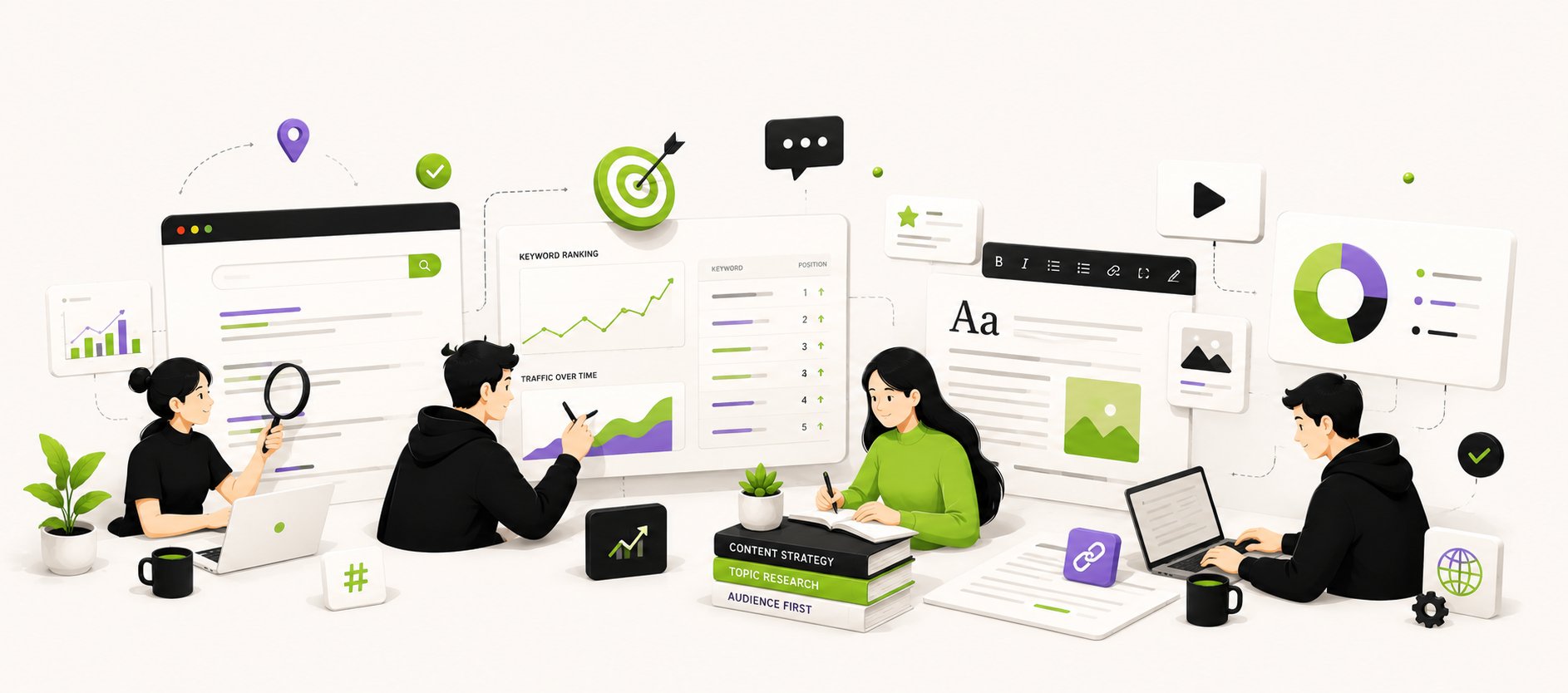
- Keyword and search intent research: figuring out the terms your potential customers actually search for, and what they expect to find when they type them in.
- On-page and technical SEO: making sure pages are structured, written, and coded in a way search engines can crawl, index, and understand.
- Content strategy and creation: building pages and articles that answer real search queries and add up to topical authority over time.
- Link building: earning credible links back to your site, which search engines still read as a signal of trust.
- Local SEO: optimizing for location-based searches, which matters for any business serving a particular city or region.
- Reporting and iteration: tracking rankings, traffic, and conversions, then adjusting the strategy based on what's actually working.
02How the Process Usually Unfolds
SEO isn't something you do once. Most engagements start with an audit of the current site and its competition, move into a prioritized list of technical fixes and content opportunities, and then settle into an ongoing rhythm of publishing, optimizing, and reporting. Search engines, and increasingly AI-driven search results, reward consistency, so results tend to build gradually rather than show up overnight. For a look at how search behavior itself is shifting, see SEO Trends Every Business Owner Needs to Know, which covers AI search results, E-E-A-T, and core web vitals.
03SEO as Part of a Bigger Growth Strategy
SEO rarely works on its own, and treating it as a standalone tactic is one of the reasons marketing efforts fall short. Edge Point Solutions started as a digital marketing agency helping Malaysian SMEs generate leads, and has since grown into a broader growth partner, combining strategy, creative content, paid advertising, SEO, and AI-powered automation into scalable digital systems that help businesses attract customers, convert leads, and grow sustainably. Seen this way, SEO is one lever among several, working alongside paid channels and content to build a system rather than a single campaign.
If your marketing efforts have historically been disconnected or reactive, it's worth reading The True Cost of Random Marketing and Why Most Marketing Plans Fail Before They Start. Both explain why a connected, strategic approach beats one-off tactics, SEO included.
04Signs Your Business Might Benefit From SEO Support
- You're relying entirely on paid ads and have no organic visibility to fall back on.
- Competitors consistently outrank you for terms your customers are searching.
- Your website gets traffic but it doesn't turn into leads or sales.
- You want a marketing channel that builds on itself over time instead of stopping the moment you stop paying for it.
05FAQ
06Is SEO a one-time project or an ongoing service?
It's ongoing. Search algorithms change, competitors change, and customer behavior changes, so SEO works best as a continuous cycle of optimization and content rather than a single fix.
07How is SEO different from paid advertising?
Paid advertising buys visibility for as long as you keep paying. SEO earns visibility organically. It tends to build more slowly, but it keeps delivering traffic without an ongoing cost per click.
08Does SEO work alongside other marketing, or replace it?
It works alongside it. SEO does best as one part of a connected strategy that also includes content, paid advertising, and, more and more, AI-driven automation.
09How do I know if my business actually needs an SEO agency?
If people are searching for what you offer and you're not showing up, or your marketing right now relies entirely on paid channels, that's usually a sign SEO is worth the investment.
10Talk to Edge Point Solutions
If you're weighing up what SEO could look like for your business as part of a broader growth strategy, get in touch with Edge Point Solutions through our website. We'll talk through where your business stands today and what a connected approach, SEO, content, paid advertising, and automation, could look like for you.
- 01The specifics vary from agency to agency, but most SEO engagements come back to the same handful of workstreams:
- 02SEO isn't something you do once.
- 03SEO rarely works on its own, and treating it as a standalone tactic is one of the reasons marketing efforts fall short.
- 04You're relying entirely on paid ads and have no organic visibility to fall back on.